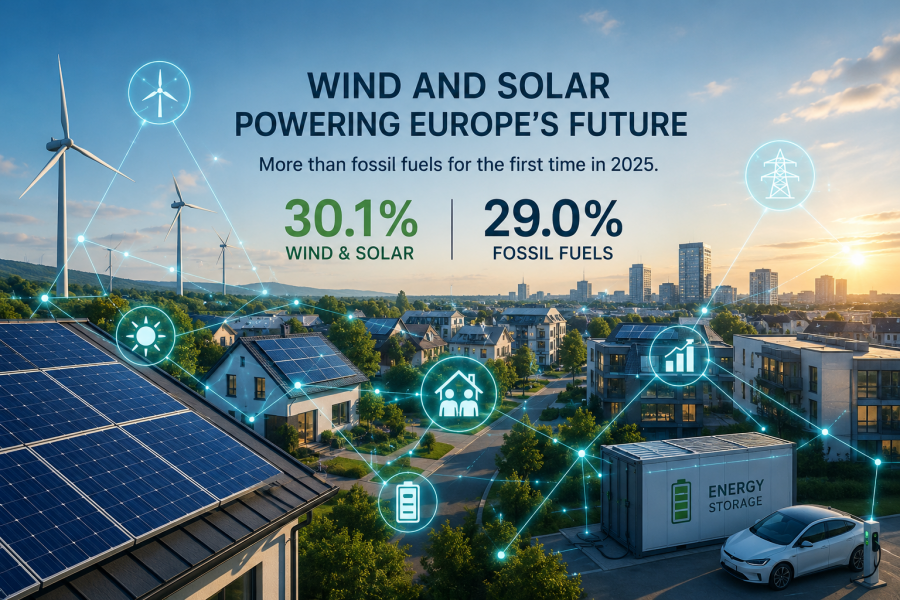
In 2025, the European Union reached a historic energy milestone: for the first time, wind and solar power generated more electricity than fossil fuels.
According to Ember’s European Electricity Review 2026, wind and solar together produced 30.1% of the EU’s electricity, while fossil fuels accounted for 29.0%. In practical terms, this means that clean, weather-dependent energy sources are no longer just supporting the electricity system. They are becoming central to it.
This shift was largely driven by the rapid growth of solar power. Reuters reported that solar capacity increased by 19%, helping renewables reach a new record despite lower hydropower generation caused by drought conditions.
But this milestone is not only about producing more renewable energy. It also shows that the next phase of the energy transition will depend on how intelligently we manage that energy.
Wind and solar power are clean, scalable and increasingly cost-effective, but they also depend on weather conditions. Solar panels produce the most electricity during sunny hours, while wind turbines generate power when wind conditions are favourable. Consumption, however, does not always happen at the same time as production.
This creates a new challenge for Europe’s electricity system: matching local energy generation with local consumption more effectively.
As renewable energy grows, flexibility becomes just as important as generation. Battery storage, smart meters, local balancing, demand-side management and digital energy platforms will all play a crucial role in making the system more stable, efficient and affordable.
Energy communities can become one of the key solutions in this new energy landscape. They allow citizens, municipalities, businesses and local institutions to cooperate in producing, sharing and managing energy.
Instead of treating consumers only as passive users of electricity, energy communities turn them into active participants. They can help use locally generated solar or wind power more efficiently, reduce pressure on the grid and support a more democratic energy transition.
The main question is no longer only how much renewable energy we can produce. It is also how well we can coordinate, store, share and use it.
The fact that wind and solar have overtaken fossil fuels in the EU electricity mix is a major signal of progress. However, it also highlights the need for smarter local energy systems.
The future of the energy transition will not be built only through large-scale renewable capacity. It will also depend on local flexibility, transparent data, digital coordination and community-based energy solutions.
At MET3R, we believe that energy communities can play a central role in this next stage. By combining digital tools, local data, smart coordination and community engagement, energy communities can help make renewable energy more practical, more efficient and more accessible.
The EU’s 2025 electricity data sends a clear message: the energy transition is already happening. The next step is to make it smarter, more local and more collaborative.
Source: Reuters, based on Ember’s European Electricity Review 2026.
